
Crisis = Opportunity
Another hail season is upon us. Mike R. in Cape Girardeau, MO got the first storm this year late February. March 1st brought a “swarm” of tornadoes across Southeastern United States.
Tragically, 19 people perished, some were teenagers at their high school. Open your heart and feel for those parents and family who lost loved ones.
Now shift gears and consider how crisis often brings opportunity.
A lot of homes will be rebuilt and a lot of money will flow into those damaged areas. Seems almost inhuman to mention tragedy and money in the same paragraph, right?
Yet this is how you must think.
On the same day these storms wreaked havoc with tornadoes, the Kansas City area got pounded with hail. For those folks with damaged cars the closest thing to tragedy they feel is a little inconvenienced to get them fixed. Should you as dent tech feel guilty from making money on someone else’s loss?
Truthfully, a lot of us do.
Never forget what you are contributing by being an important part of the recovery process. If you didn’t fix their car, they would be reliving that event every time they looked at it. Cars are the second largest purchase they make, right? So to them it’s a big deal.
Insurance companies call it restoring the vehicle to pre-loss condition. Sounds clinical and cold, so never forget all the intangible value that you give besides just the repair.
When people get hail it is unusual, and it’s a big event in their life. While you are estimating the repair, they will want to tell you their story. It is the same story you’ve heard 80 times that day, but please, honor them by listening. Give a sympathetic nod and then tell them you can make it all better. With full confidence and a smile, say, “I can make your car look like it was never damaged, and you keep your factory paint, guaranteed.”
You will get a lot of business this way. You’re not just there to repair the car. You are helping them to recover. To get their life back to where they were before the storm.
Who wants to be just a dent tech anyway? Where’s the vision in that?
Many companies have a mission statement, and they proudly display these in waiting rooms and on web sites. Truth is, they are written for owners and employees. They are designed to give a sense of ownership and pride.
For you, as you push on metal daily, I believe you would be well served to have a written statement, but let’s call it a “Vision Statement” instead.
I will give suggestions, but you need to make this your own.
“My purpose in the dent repair business is to help people who have suffered a loss to their car. I will fix their dent when I am able or I will refer them to someone who will. I will give my best quality at all times as I move with pride. I will be their beacon of hope as I remember their anguish and frustration caused by this unexpected loss.”
Go the Extra Mile
Years ago, I read about the “extra mile philosophy”. People respond and give you more business if you make them feel you went the extra mile for them. When you act as stated above, this is what you are giving. You only have to give a little more than your competitior to win.
I like the example of water. The difference between hot water and boiling water is one degree. You have hot water all the way up to 211 degrees. One more degree and it’s boiling. Often, one more thing is all it takes to set you apart.
This extra mile thinking paid off for me 13 years ago. I had a customer’s car and needed to keep it longer than expected. I called him and he unleashed a litany of reasons why this was going to inconvenience him to the extreme. I listened and could see and feel that he wasn’t just griping, this was going to be a real problem. Many management schools will tell you that listening and empathizing is good for it helps to diffuse their frustration. True enough. But that’s not extra mile thinking is it?
He told me his wife was ill and now his young son was too. He lived 15 miles away and no way could he come get it when I would be done. “No problem, I’ll bring it to you.”
This calmed him down, but he was astonished when I rang his doorbell with flowers in one hand for his wife and some coloring books for his son.
There is kind of a dirty side to all this I want you to avoid. If you’ve ever been to a repair house and heard this, you’ll know what I mean.
“The technician is really busy and we don’t normally do this, but I got them to…”
Don’t fake it and don’t blow your horn about it. Let them notice and know that you touched them even if they don’t say it.
By the way, have you noticed how important it is how you think? In a world of chaos, it truly is the only thing you have real control over.
‘Tis why I want to address a disadvantage you have of learning at home.
Sometimes in a city with a hail storm, the dent tool companies will send a sales guy in to see if you need clips, plugs or tools. Smart method, for you have money to spend and they have things to sell.
I remember the guy from Anson Industries telling us about the shops he would go into and how there was always a guy in the corner, working on a junk hood, training.
Every once in a while the trainer would leave his hail car, go into the corner and look at the hood. Then he would say, “You’re doing really well, keep practicing.” The trainer would then go back to his hail car and start pushing again.
Yes, that trainee paid 5000 or more for some pats on the back.
The Paintless Mentor System is great. It will teach you dents. But I don’t know how to duplicate this yet. If I were there with you, I would. Why is this important?
You need to hear it. So here you go: “You’re doing great. I can see where you are getting better. Keep pushing.”
I’m being tongue in cheek here, but all who have been around other dent guys quickly realize there’s nothing outstanding about other techs. There’s nothing they have that you don’t. Embed this in your brain and body and you’ll be among the best.
For this reason the Coaching portion of this program is crucial to your success. Watching me take out dents, seeing my mistakes, seeing the flaws as ruthlessly exposed by the camera, all this will make you one day say, “I can do what Tim does”. Exactly.
Seriously, get yourself a digital camera and each week, take a picture of one of your dents and send it to me. Better yet, send me a photo of the one you thought turned out well and send me one that gave you fits.
You need this and I need it to help you.
I flat guarantee if you are applying the PM System and you came here and did a dent right in front of me, it would be outstanding.
How knowing little was a true advantage
Dent repair is so simple. I will never forget my boss drawing the stripe on a napkin and then me watching him do a couple of dents.
Today we have the stripe and the shadow or fog as you know. The shadow makes deep dents readable.
I believe your path is fraught with danger more today than it was back then. Why?
This is the formula: trainer takes out dent, shows the stripe method says go practice.
Trainee sees that trainer took out dent, has no choice but to believe that he used the method just shown. Now puts it to use through practice. Simple.
We knew we didn’t know what we didn’t know.
Today, there is an “industry” with trainers who will sell you on your inadequacy. “That guy makes a lot of mistakes,” they’ll tell you, or “That guy has a lot of bad habits”.
Be careful. Folks will prey on your frustration if you let them. All the while they know the only difference for their success is they did not give up. You will get frustrated, when you do call me or drop me an email. Let’s talk about it.
Would daVinci make a good dent guy?
I heard an interview with Michael J. Gelb the author of “How to Think Like Leonardo da Vinci: Seven Steps to Genius Every Day”. So much applies to this business I will share it with you. His beliefs are in Italian then translated.
- Curiosita (curiosity) – Leonardo was inquisitive, but he did so in an organized way. He always kept paper and pen with him and recorded his thoughts. He was criticized for the disheveled look of his notes, though. Pages often had drawings, various musings of his mind, and even jokes. He believed in a free mind. In paying attention to the still small voice we call intuition.
You do this when you are examining a dent for what caused it or what got bent first. Your curious mind will lead you to answers. Like where to push first. Ask, make a push and watch it in the light. The answer is there.
- Dimonstrazione – (demonstration) da Vinci wanted to prove things to himself. He dissected more than 30 bodies and today his drawings are the most accurate of his time. There were already drawings of the human body, but he believed in “Ostinate Rigore” or independent thought. In his day it was considered wrong to question, but he did and wound up proving or improving accepted norms.
Today, there may be a little too much independent thought.
When you are starting, please be humble enough to listen to the teacher. As you apply this teaching, make it yours and strive to be profiecient. Then you may experiment and do your own dissections.
Remember the trap of “yeah but wouldn’t it be better if I….”
Maybe. First, earn your wings and then question.
- Sensazione (sensation) – da Vinci called the senses “the Five Ministers of the Soul”. He believed in training the senses like an Olympian might train for a contest.
Five hundred years ago, he wrote, “the average person hears without listening, sees without looking, breathes without smelling the aromas…”
To him, the senses are driven down to the lowest common denominator if they are not elevated.
For this reason he wore the finest velvets and silks he could afford.
He also practiced “Saper Vedere” which means “know how to see.” He trained his visual acuity so well, that he could see a bird in flight and draw it later with amazing clarity. In fact it was not until the invention of stop motion photography in our day that his drawing was proved accurate. He truly saw what others missed.
For you, until you learned to see dents, you may not have noticed them. Now they stand out like sore thumbs.
I know da Vinci would have had fun seeing eyebrows or sharp dents where no push is visible.
You can train your eyes and senses just like he did. Play the game of “I don’t see it but I know it’s here.” You are opening your mind and it is taking in this new vision.
Which leads to…
- Sfumato (openness to the unknown) – everyone wants to know “what is Mona Lisa smiling about?” Da Vinci knew and the author tells of some school age children who picked up on it right away.
They knew this famous painting was drawn so as to be gender neutral. It was da Vinci’s belief that everything has an opposite. The Mona Lisa’s smirk is her awareness of this.
You now make money with opposite reaction. If it can be bent, it can be unbent. Maybe not paintless, but you catch the drift.
Look at those fixable dents and smirk like Mona.
- Arte scienza (balance of art and science) – Leonardo was not just a genius, he was a good salesman too. His resume sent to the Prince whom he wanted to work for touted his ability to craft new weapons (but that’s not all!) with the added benefit of his painting and sculpting skills as well.
Today his drawings like the mock up of a helicopter, were scientifically accurate but also artistic.
You know what makes metal move, and the steps to follow. You make art as you reshape and sculpt it back in the best way possible.
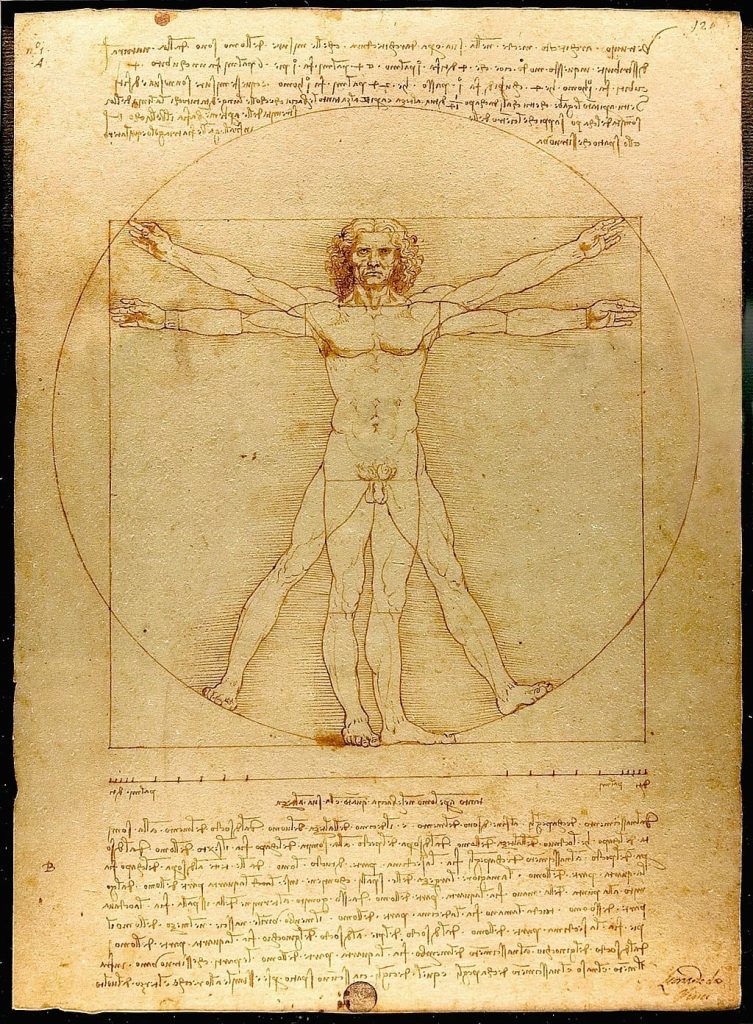
- Corporalita (Balance the body and the mind) – on top of all his skills, Leonardo was also known as the strongest man in Florence. He may well have been the first health food nut. He often taught his pupils “Learn to preserve your own health”. His famous drawing of the Vitruvian Man (fig. left) which shows a man with arms outstretched and balanced represents his view of health. Tying this with his exercising of the senses, he ate for the pleasure of working out his taste buds.
Admittedly, I struggle with this as my weight has gone back up from wintertime lazing and grazing. Eating a big lunch means struggling to bend over and take out a door ding.
No doubt da Vinci would have been fast at dents also. His high energy levels would have made it so. - Connessione (everything connects) – he was the first “systems thinker”. He looked for the connection in everything.
To quote: “When a small bird alights on a tree all the world is affected thus.”
Interestingly, his favorite picture was of a stone thrown into a pond and the ripples it creates. No doubt he would be fascinated as you are today at the ripples created in sheet metal as a dent occurs.
Going beyond that, what are the connections made in the mind of your customer about you and your business? How can you tip that scale in your favor?
Above everything, what made Da Vinci a genius was his asking great questions. Dent repair and business are all about good questions.
Bottom line: to think like a genius, ask, then be open to the answer. When it comes to you, act on it immediately if you can. Write it down if you can’t.
Till next time,
Tim Olson